

Reviewed and signed off by Blue Blossom Surveys· Published 17 November 2026 · Updated 17 November 2026
On many houses, the flat roof is not over the main house at all. They sit over a rear kitchen extension, a garage, a dormer or a porch, and they are often the part of the property that has been patched the most. That is exactly why they deserve a careful look before you commit.
If you are buying a house with a flat roof, the question is rarely “is a flat roof bad?” It is “what condition is this one in, what is it made of, and what might it need in the next few years?” A good survey helps you answer those questions before exchange rather than after the first heavy downpour.
Quick answer: A RICS Level 2 or Level 3 survey will look at a flat roof’s covering, edges, drainage and the ceilings below it for signs of leaks. Under the RICS standard, the surveyor can use a ladder to view flat roofs no more than 3m above level ground, where it is safe. Higher or inaccessible roofs are viewed from vantage points, and anything that can’t be seen is recorded as a limitation. Older, patched or large flat roofs often justify a Level 3 survey.
In this guide
Why flat roofs on a house get extra attention in a survey
A pitched roof sheds water quickly. A flat roof relies on a continuous waterproof layer and a gentle fall to move rainwater towards a gutter or outlet. When the fall is too shallow, the outlet blocks, or the covering splits, water sits on the surface and looks for a way in.
Flat roofs also tend to be where the “add-ons” live. Extensions, garages and dormers are often built at different times, by different builders, to different standards. The joint between the flat roof and the main wall of the house is a common weak point, because it depends on flashings and upstands that can crack or pull away as materials move.
None of this means a flat roof is a problem. Plenty are sound and well maintained. The point is that the condition varies much more from house to house than it does with a typical tiled roof, so you want someone independent to look at the one you are buying.
What the surveyor checks on a flat roof
During a RICS Level 2 Homebuyer Survey or a Level 3 Building Survey, the surveyor looks at the flat roof as part of the roof coverings and the rooms below. In practice, that usually includes:
- The covering material. Common types include bituminous felt, EPDM rubber membranes, GRP (glass reinforced plastic, often called fibreglass), mastic asphalt and lead. Identifying the material helps you understand how it has been maintained and what repairs typically involve.
- Surface condition. Splits, cracks, blisters, rippling, lifting at the edges and areas of patch repair are all noted. Several different generations of patch can suggest a roof that has been nursed along rather than replaced.
- Ponding. Standing water, or the tide marks and silt left behind when it dries, may indicate inadequate falls or a deck that has sagged.
- Edges, upstands and flashings. The detail where the roof meets a wall, a parapet or a window is where many leaks begin.
- Drainage. Gutters, outlets and downpipes are checked for blockages, poor falls and overflow staining.
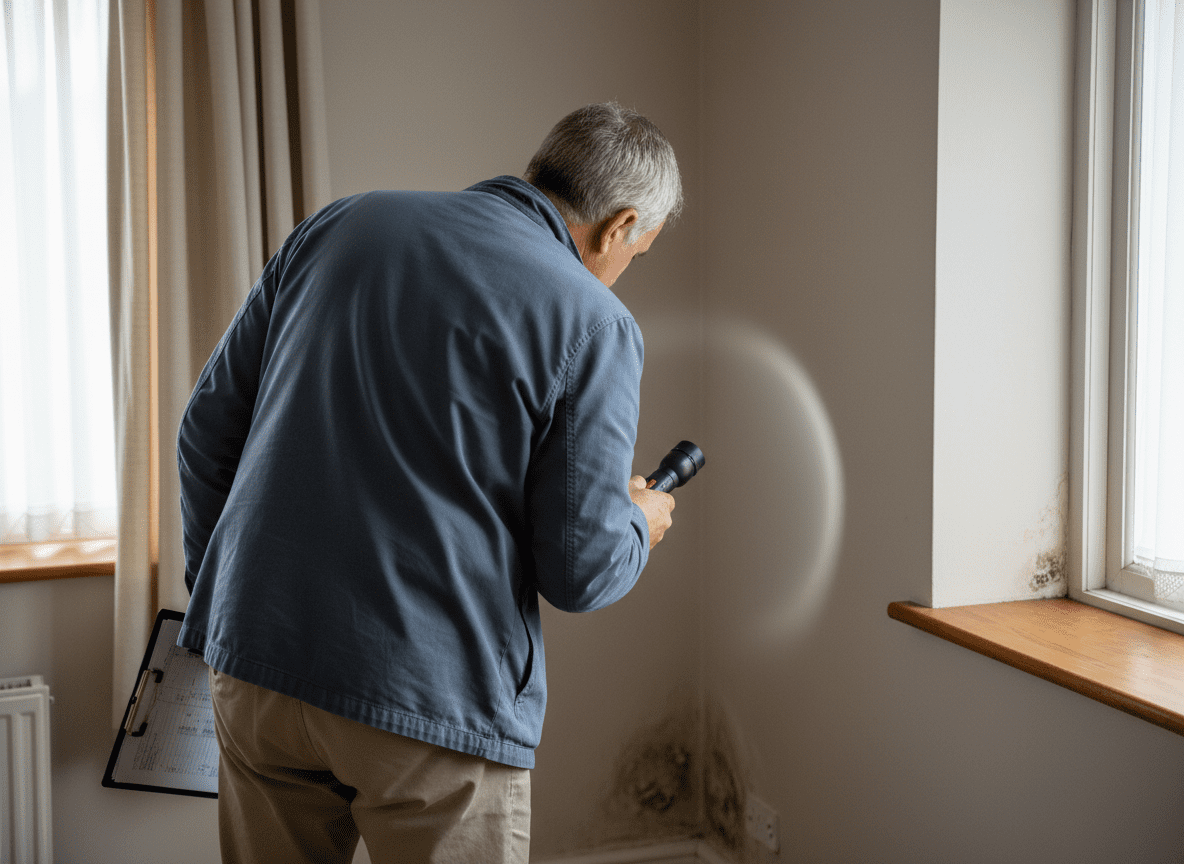
- The ceilings below. Stains, cracking, bowing or fresh decoration on a ceiling under a flat roof can point to past or current leaks. The surveyor may use a damp meter where readings would help.
The report then gives the roof a condition rating and explains what, if anything, needs doing. If you want a refresher on how those ratings work, our guide to how a Level 3 survey checks the roof and loft covers the wider roof inspection in more detail.
What a surveyor can and can’t reach
This is the part most buyers don’t realise. A home survey is a non-invasive, visual inspection. The RICS description of the Level 2 service says the surveyor uses a ladder for flat roofs no more than 3m above level ground, if it is safe to do so. The Level 3 description uses the same limit.
So a single-storey kitchen extension is usually within reach. A flat roof over a two-storey rear addition, or a dormer high on the main roof, usually is not. In those cases the surveyor views what they can from the ground, from upstairs windows or from neighbouring vantage points, and records what could not be seen.

The surveyor also does not open up the structure. That means they won’t cut into the covering to check the deck, lift insulation or remove ceiling boards. Problems hidden inside the roof build-up, such as a rotten deck board or trapped condensation, may only show through indirect signs like a soft area underfoot or staining below.

On some inspections we can use a drone to get a closer look at roofs that are out of ladder reach. It is a useful extra view, but it is still visual, and it doesn’t replace a roofer’s intrusive inspection where the report recommends one. It is also worth reading our guide to what a home survey won’t cover so the limitations section doesn’t come as a surprise.
Our view: The limitations section of your report matters as much as the condition rating. If the surveyor says the flat roof “could not be inspected closely”, treat that as a to-do item, not a formality. Ask the seller for evidence of the roof’s age and history, and consider a roofer’s inspection before exchange.
Warning signs to note at a viewing
You don’t need to climb anything to spot early clues. On a second viewing, look for:
- Brown rings or fresh paint on ceilings directly under the flat roof
- Mould or a musty smell in the extension or garage, especially in corners
- Water stains on the outside wall below the roof edge or outlet
- Moss, plants or a visible dip on the roof when seen from an upstairs window
- Silicone or tape around the joint between the roof and the house wall
- A garage roof sagging between supports
These don’t prove there is a defect, but they are worth mentioning to your surveyor when you book, so they can pay particular attention. A few of them together, on a roof the seller can’t date, is a strong reason to budget for a closer inspection.
Re-roofing, repairs and building regulations
It helps to know when work on a flat roof needs building control involvement, because it affects the paperwork your solicitor may ask for and the cost of doing the job properly.
According to the Planning Portal’s guidance on work to an existing roof, repairs or re-covering do not normally need a building control application if less than 25 per cent of the total building envelope and less than 50 per cent of the roof are affected. Approval is needed beyond those limits, for structural alterations, or where a new covering increases the roof’s weight by 15 per cent or more.
There is also an energy efficiency angle. A roof counts as a “thermal element”, and the Planning Portal’s re-roofing guidance explains that replacing a flat roof with integral insulation may mean upgrading that insulation. In practical terms, a full replacement is often more than a new top layer.
| What you find | What it may mean | Sensible next step |
|---|---|---|
| Recently replaced roof with paperwork | Lower short-term risk | Ask your solicitor to check any guarantee and whether building control sign-off was needed |
| Older roof, sound but weathered | May need replacing in the medium term | Factor it into your budget and your offer |
| Ponding, splits or multiple patches | Possible leaks now or soon | Get a roofer’s quote before exchange |
| Ceiling stains or damp below | Water may already be getting in | Further investigation of the deck and ceiling |
If quotes come back higher than expected, our guide to negotiating the house price after a survey explains how to use the findings calmly and fairly.
Buying a house with a flat roof: Level 2 or Level 3?
It depends on the age, type and condition of the property, not just the roof. As a rough guide:
- A Level 2 survey is often suitable for a conventional, reasonably modern house with a small flat roof over a single-storey extension or garage that is in visibly fair condition.
- A RICS Level 3 Building Survey is usually the better choice where flat roofing is extensive, the house has been altered several times, the roof is old or heavily patched, or you are planning work of your own.
A Level 3 report goes further into the likely causes of defects and the options for repair, which is useful when the flat roof is a significant part of the building. If you are still weighing it up, our guide to choosing the right survey sets out the differences side by side.
We regularly inspect properties with flat-roofed extensions and garages across Peterborough, Corby, Stamford and the surrounding towns. Flat-roofed additions are a familiar feature across the area, and they are always worth a careful look.
Questions to ask the seller about a flat roof
Your solicitor will raise formal enquiries, but it is worth asking the agent early:
- When was the flat roof last replaced or re-covered, and by whom?
- What material is it, and is there a guarantee that can be transferred?
- Have there been any leaks, and what repairs were done?
- Was building control involved if the whole roof was replaced?
- Has anything been added on top, such as solar panels, a balcony or a roof light?
Clear answers, with invoices, are reassuring. Vague answers aren’t a reason to walk away, but they are a reason to rely more heavily on the survey and, where recommended, a roofer’s inspection.
Buying a home with a flat-roofed extension, garage or dormer? Blue Blossom Surveys provides independent RICS Level 2 and Level 3 surveys across Peterborough and the surrounding area. We will tell you what we can see, what we can’t, and what to do next. Get in touch to talk through your purchase.
Frequently asked questions
Do surveyors go on flat roofs?
A home survey is a visual inspection. Under the RICS home survey standard, the surveyor may use a ladder to view flat roofs no more than 3m above level ground where it is safe, and otherwise inspect from the ground, windows and other vantage points. Anything not seen is recorded as a limitation.
Is it a bad idea to buy a house with a flat roof?
Not necessarily. Many flat roofs perform well when they are properly built and maintained. What matters is the condition, age and material of the roof on the house you are buying, and whether you have budgeted for its maintenance or eventual replacement.
Can a flat roof affect getting a mortgage?
A flat roof over part of a conventional house is common and doesn’t usually cause issues on its own. Where the lender’s valuer sees signs of disrepair, they may ask for further investigation or hold back funds until work is done. Your broker can confirm how your lender treats it.
What does a survey look for on a flat roof?
The surveyor looks at the covering material and its surface condition, signs of ponding, the edges and flashings where the roof meets walls, the gutters and outlets, and the ceilings underneath for signs of leaks. The findings are summarised with a condition rating and advice on next steps.








0 Comments