

Reviewed and signed off by Blue Blossom Surveys· Published 19 November 2026 · Updated 19 November 2026
The RICS Level 2 survey report has its own heading for conservatories and porches. That tells you something useful: a conservatory is treated as a distinct part of the building, with its own typical defects, rather than just “another room”.
If you are buying a house with a conservatory, it is worth understanding what the surveyor will look at, the problems that come up most often, and the one question many buyers miss entirely. Is it really a conservatory at all, or has it quietly become an extension?
Quick answer: A home survey inspects a conservatory visually, covering the roof, frames, glazing, base walls, floor and the junction with the house, and rates its condition. Common findings include leaking roof panels, failed seals, condensation, and cracking where the conservatory meets the house. The surveyor will also flag features, such as a solid roof or removed doors, that your solicitor should check against building regulations.
In this guide
Where the conservatory sits in your survey report
In the RICS Home Survey Level 2 report format, the outside of the property is broken into elements, and one of them is headed “Conservatory and porches”. Your surveyor records what they saw there, gives it a condition rating, and explains what it means for you.
In a RICS Level 2 Homebuyer Survey, you get a clear picture of the conservatory’s condition and whether anything needs attention. A Level 3 Building Survey goes further into the likely causes of defects and the options for putting them right.
Either way, the inspection is visual and non-invasive. The surveyor won’t dismantle roof panels, lift floor coverings or cut into walls. Where something can’t be seen, the report says so.
What surveyors commonly find in conservatories
Conservatories are lightweight structures that face a lot of sun, rain and temperature swings. That shows up in a fairly predictable set of issues.
Roof leaks and failed seals
Polycarbonate and glass roof panels rely on seals, gaskets and glazing bars to stay watertight. Over time these can shrink, crack or slip. Look for water marks on the floor, stained sills and dripping at the glazing bars after rain.
Misted or damaged glazing
Double-glazed units that have fogged between the panes have usually lost their seal. They don’t normally mean the structure is failing, but they are a cost to replace. Cracked or discoloured roof sheets are also noted.
Condensation and mould
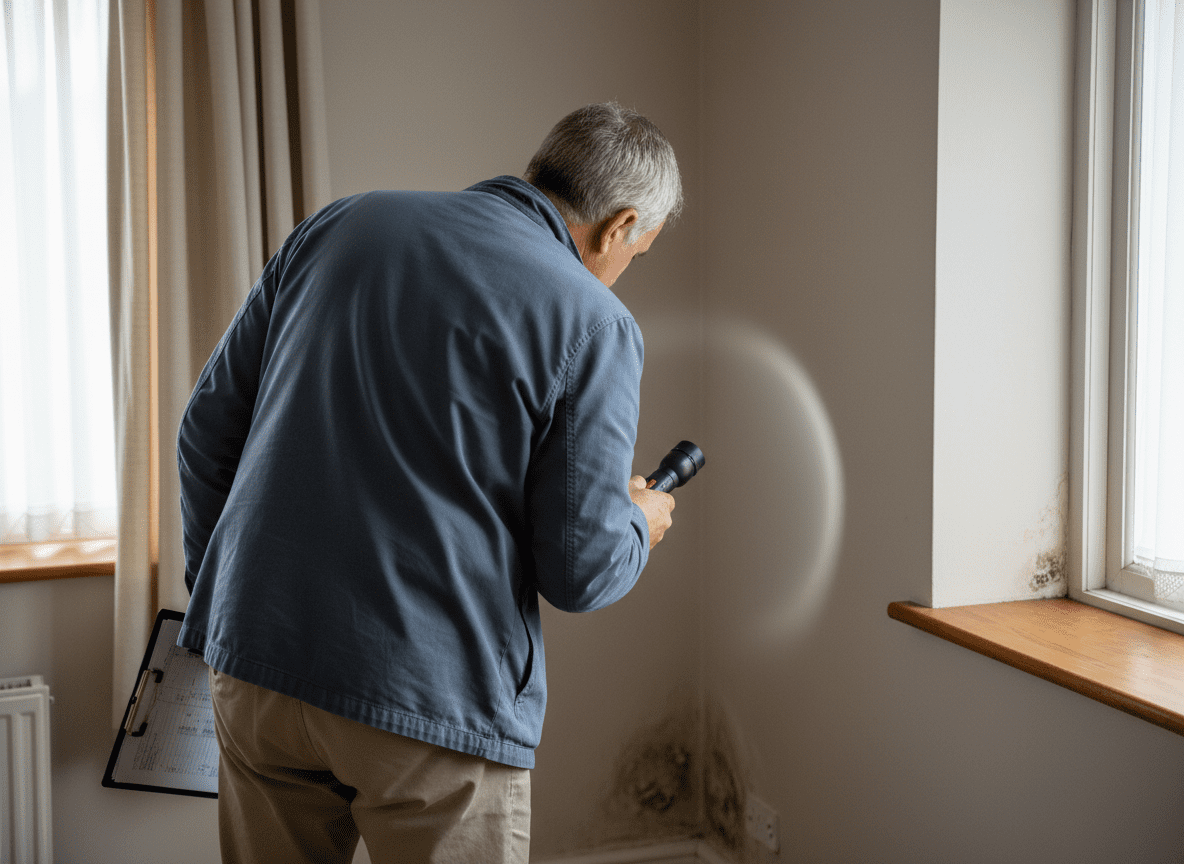
Glass and uPVC surfaces get cold quickly, so conservatories are prone to condensation. Mould in corners, around frames and on sills is a common result, particularly where the room is used year-round with limited ventilation.

Movement at the junction with the house
A conservatory often sits on its own, lighter base, separate from the foundations of the house. The two can move differently. Cracks in the dwarf walls, gaps opening at the wall plate where the conservatory meets the house, and doors that bind are all signs the surveyor will note.
Base walls, floors and damp
The low “dwarf” walls and the floor slab are checked for cracking and dampness. If the conservatory has been built across an existing airbrick, or has raised the ground level against the house wall, the surveyor may flag a risk of damp or poor ventilation to the main building. If damp does come up in your report, our guide on what to do when a survey flags damp explains the sensible next steps.
Rainwater goods
Conservatory gutters are often small and easily blocked by leaves. Overflowing gutters can soak the base walls and the house wall behind, so the surveyor looks at how water is being carried away.
Conservatory or extension? Why the difference matters
This is the question that catches buyers out. Many conservatories are exempt from building regulations, but only while they stay within certain conditions. The Planning Portal’s building regulations guidance on conservatories says they are normally exempt when they are:
- built at ground level and under 30 square metres in floor area
- single storey
- separated from the house by external quality walls, doors or windows
- heated by an independent system with separate temperature and on/off controls
- fitted with glazing and any fixed electrics that comply with the relevant regulations
The same guidance says any new structural opening between the conservatory and the house needs building regulations approval, even if the conservatory itself is exempt.
In practice, that means a few things a surveyor may spot deserve a question:
- The original patio doors between the house and conservatory have been removed to make it open plan
- A wall has been knocked through to create a wider opening
- Radiators run off the main house central heating
- The glazed roof has been swapped for a solid, tiled or insulated one
None of these is automatically a problem. It depends on what was done, when, and whether it was approved. The surveyor’s job is to point out what they see and raise the question. Your solicitor’s job is to check the paperwork and advise on the legal side. We stay in our lane on that, and so should any surveyor.
Our view: Removing the doors to make a conservatory open plan is a change buyers often come across. Buyers often love the space, and there is nothing wrong with that. Just make sure your solicitor sees the surveyor’s comments early, so any questions about approvals are raised before you are close to exchange.
Conservatories with a replacement solid roof
Replacing a glass or polycarbonate conservatory roof with a solid, insulated one is a popular upgrade because it makes the room more comfortable in summer and winter. It is also a significant change in weight.
LABC guidance on replacing a conservatory roof states that swapping a translucent roof for a solid one needs a building regulations application. It notes that most conservatories can take the extra load, but that the pitfalls include inadequate foundations that could settle differently from the house, leading to cracks and leaks, and window or door frames not designed to carry the roof.

So if the house you are buying has a conservatory with a solid roof, the surveyor will pay close attention to:
- cracking in the base walls or where the frame meets the dwarf wall
- frames that are bowing, doors that stick, or glazing units under stress
- any sagging or unevenness in the roof line
- signs of leaks where the new roof meets the house wall
Ask the seller when the roof was replaced, who fitted it, and whether building control signed it off. The answers help your solicitor and give context to anything the surveyor finds.
If the survey flags a problem with the conservatory
Most conservatory findings are maintenance items, not reasons to pull out. A sensible approach:
- Read the condition rating and the explanation together. A rating tells you how urgent something is; the text tells you why.
- Get quotes for anything significant. A new roof panel, resealing or replacement glazing units can be priced by a specialist before exchange.
- Pass building regulations questions to your solicitor. They will advise on what paperwork is needed and the options if it is missing.
- Where movement is noted, ask about its likely cause. If cracking suggests the base is settling, further investigation may be recommended before you commit.
- Use the findings to renegotiate if appropriate. Our guide to what to do when a home survey reveals problems walks through the options.
Buying a house with a conservatory: which survey to book?
The conservatory itself rarely decides this. It depends on the age, type and condition of the whole property.
For a conventional, reasonably modern house with a standard conservatory in fair condition, a Level 2 survey is often suitable. Where the house is older, has been extended several times, or the conservatory has been heavily altered with a solid roof or knocked-through walls, a RICS Level 3 Building Survey gives you more detail on causes and repair options.
If the property has other additions too, such as a kitchen extension or loft conversion, our guide on whether surveyors check extensions and loft conversions is a useful companion read.
Buying a home with a conservatory in Peterborough or the surrounding area? Blue Blossom Surveys provides independent RICS Level 2 and Level 3 surveys, with clear, practical reports that tell you what matters and what to do next. Get in touch to talk through your purchase.
Frequently asked questions
Do surveyors check conservatories?
Yes. A RICS home survey includes the conservatory as part of the outside of the property. The surveyor inspects its roof, frames, glazing, base walls and floor visually, and gives it a condition rating with advice on anything that needs attention.
Does a conservatory need building regulations approval?
Often not, provided it is single storey, at ground level, under 30 square metres, separated from the house by external quality doors or walls, independently heated, and has compliant glazing and electrics. A new structural opening into the house needs approval even when the conservatory itself is exempt.
What problems do conservatories commonly have?
Common issues include leaking roof panels and seals, misted double-glazed units, condensation and mould, blocked gutters, and cracking where the conservatory meets the house. Many are maintenance items, but movement cracks may need further investigation.
Is a conservatory with a solid roof a problem when buying?
Not necessarily. Swapping a glazed roof for a solid one needs building regulations approval, so ask whether it was signed off. The survey will look for signs the structure is struggling with the extra weight, such as cracking, bowing frames or sticking doors.







0 Comments