

What a Home Survey Won’t Cover: Understanding the Limits of a Property Survey
A RICS home survey is one of the most valuable steps you can take when buying a property. It provides an independent, professional assessment of the property’s visible and accessible condition — and for most buyers, it’s the clearest picture they will get of what they’re committing to before exchange.
But a survey doesn’t cover everything. Understanding what falls outside its scope helps buyers make informed decisions about what additional investigations they may need — and avoids unrealistic expectations about what a survey report will tell them.
The short answer
A home survey is a visual inspection of accessible elements. It does not involve specialist testing, invasive investigation, legal searches, or assessment of hidden systems. Items excluded from scope are typically flagged by the surveyor with a recommendation for further investigation by an appropriate specialist.
What a Home Survey Does Cover
It helps to start with what a RICS home survey does include, so that the exclusions make sense in context. Whether you choose a Level 2 Homebuyer Survey or a Level 3 Building Survey, the inspection covers the visible and accessible condition of the property’s main structural and external elements.
This typically includes the roof (to the extent visible from ground level and from within the loft), external walls, chimney stacks, windows and doors, floors, internal walls and ceilings, drainage (by flushing and visual inspection), and a general overview of services such as heating, gas, electrics, and water. Each element is assessed for condition and rated accordingly, with comments on any issues identified and, where appropriate, recommendations for further investigation.
A Level 3 Building Survey goes further than a Level 2 in depth and detail — but both operate within the same fundamental boundary: the surveyor inspects what is visible and accessible, describes what they find, and advises on what should be investigated further by specialist contractors where needed.

What a Home Survey Does Not Cover
The areas outside survey scope fall into several clear categories. It’s worth understanding each of them before you read your report, so that the exclusions don’t come as a surprise.
Concealed and hidden areas
A survey is a visual inspection. The surveyor does not lift floorboards, remove plasterboard, pull back carpet, open up wall cavities, or disturb fixed finishes in any way. This means that defects hidden behind finishes — damp within a wall concealed by fresh plaster, timber decay beneath a floor covering, wiring running through wall chases — may not be visible at the time of inspection.
The surveyor will note where finishes have been recently renewed and may flag this as a risk area where confirmation of underlying condition would be prudent. They will also use a moisture meter on accessible wall surfaces, which can indicate elevated readings even where surfaces appear dry — but this is not the same as a full damp investigation.
Areas that cannot be safely accessed
The surveyor inspects all areas that are safely and reasonably accessible. If the loft hatch is sealed, if a roof area requires specialist access equipment, or if a cellar is locked or flooded, these areas will be excluded from the inspection and noted in the report. The survey will describe what could and could not be inspected, and what further investigation is recommended.
Services and Specialist Systems
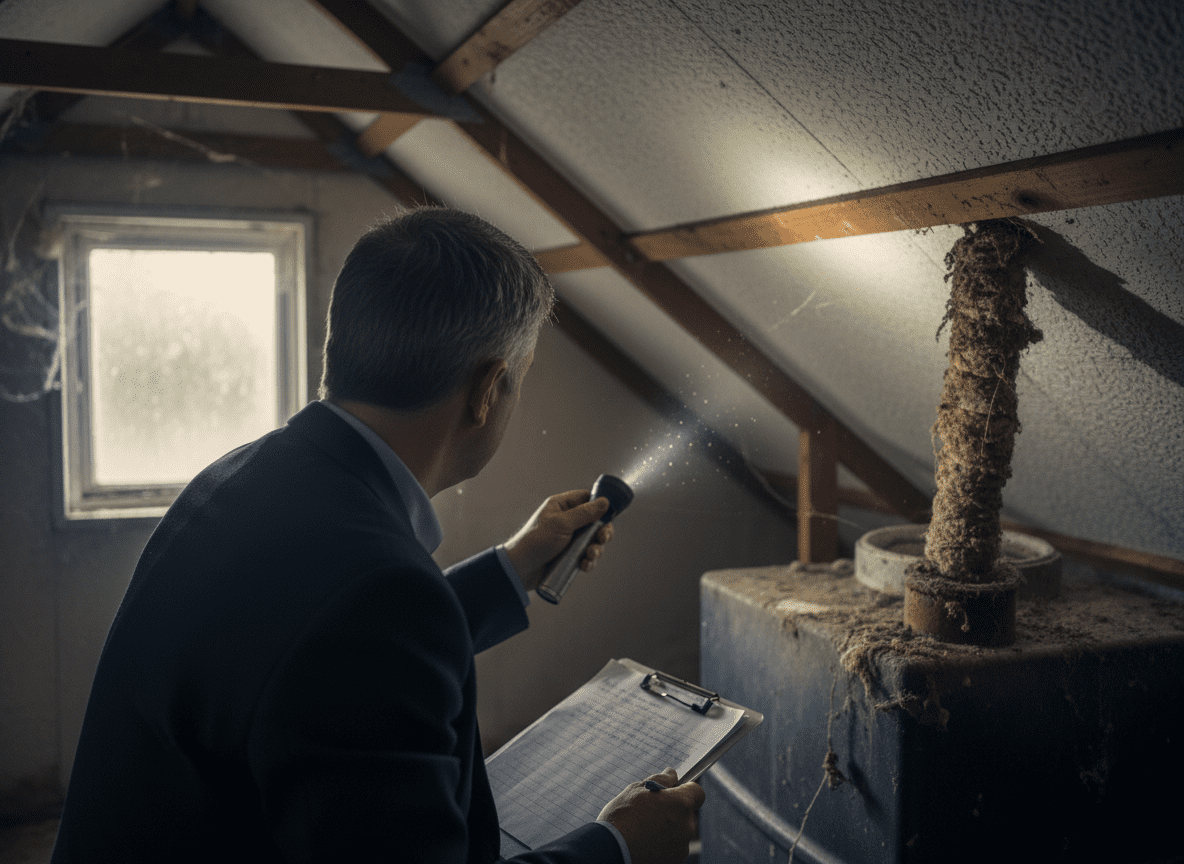
A home survey includes a general visual assessment of services — heating, electrical installation, gas pipework, plumbing, and drainage — but it is not a specialist test of any of these systems. The surveyor will note visible condition, age where identifiable, and any obvious deficiencies, but they will not carry out a gas safety inspection, an EICR (electrical installation condition report), a boiler service, or a drainage CCTV survey.
Gas and heating
The surveyor will observe the visible condition of pipework and the heating system and note any obvious concerns. They are not gas engineers and cannot carry out a Gas Safe inspection or test appliances. A gas safety certificate from the vendor and a boiler service record are separate documents that your solicitor may request — the survey will not replace these.
Electrical installation
The survey will note the visible type and apparent age of the consumer unit, the general layout of visible wiring, and any obvious concerns. It will not include the full 18th Edition wiring regulations check that an EICR provides. For properties with older wiring — particularly pre-1960s properties with rubber-insulated cables — the survey will strongly recommend an EICR by a qualified electrician before exchange.
Drainage
Flushing visible drainage points and inspecting accessible drainage runs is included in a standard survey. What is not included is a CCTV inspection of the underground drainage system. Where the surveyor has reason to suspect drainage problems — slow drainage, unusual smells, soft ground near drain runs, or evidence of previous blockages — they will recommend a specialist CCTV drain survey. This is a separate instruction typically arranged through a drainage contractor.
Specialist systems
Swimming pools, solar panels, underfloor heating systems, CCTV installations, home automation systems, septic tanks, and oil storage tanks all fall outside the scope of a standard survey. Where present, the surveyor will note them and may comment on visible condition, but specialist assessment of their operation and condition requires a specialist contractor.
Legal and Environmental Matters
A home survey is not a legal search and does not replace the searches carried out by your solicitor. There is an important distinction between the physical condition of a property — what a survey addresses — and the legal and environmental context in which it sits.
| Matter | In survey scope? | Where to get this information |
|---|---|---|
| Planning permission for works | No | Local authority search / solicitor |
| Building Regulations approval | No (surveyor may note absence of evidence) | Local authority records / solicitor |
| Flood risk | No | Environment Agency / local authority search |
| Ground contamination | No | Environmental search / specialist |
| Japanese knotweed on neighbouring land | No | RICS knotweed specialist if suspected |
| Radon gas levels | No | PHE radon map / specialist radon test |
| Chancel repair liability | No | Legal search / solicitor |
| Rights of way and easements | No | Title register / solicitor |
The surveyor may comment on matters that come to their attention during the inspection — for example, noting that a property appears to be in a flood-prone area, or that a rear access path may be subject to a right of way — but these observations do not replace the formal searches your solicitor carries out.
When Is a Specialist Report Needed?
One of the most useful functions of a RICS survey is identifying where specialist investigation is warranted. A surveyor is not a structural engineer, a gas engineer, an electrician, a drainage specialist, or a Japanese knotweed expert — but they know when to recommend one. Common specialist reports that surveys lead to include:
- Structural engineer’s report — where there is evidence of significant movement, cracking, or foundation concerns.
- Timber and damp specialist report — where the surveyor identifies moisture readings or timber condition concerns that warrant further investigation.
- CCTV drain survey — where drainage inspection raises concerns about underground infrastructure.
- EICR (electrical installation condition report) — where the electrical installation is old or visibly in poor condition.
- Japanese knotweed assessment — where knotweed is identified or suspected on or near the property.
- Asbestos survey — where the property contains materials likely to contain asbestos that need a specialist assessment.
A recommendation for a specialist report in your survey is not a sign that something is necessarily wrong — it is the surveyor being thorough about the boundaries of their inspection. Acting on those recommendations before exchange gives you the full picture you need.
Frequently Asked Questions
Will the survey tell me if the roof needs replacing?
The surveyor will inspect the roof covering from ground level and from within the loft where accessible, and will note visible signs of deterioration, missing or slipped tiles, damaged flashings, or signs of leakage. They can give an assessment of the roof’s condition and remaining life based on what is visible. They will not physically access the roof surface unless safe access is available — and this is standard practice for RICS surveyors.
Does the survey check for asbestos?
The survey will note materials that may contain asbestos — commonly artex ceilings, insulation board around pipework, old floor tiles, or roof sheeting — and will advise on condition and risk. A full asbestos management survey or refurbishment survey requires a licensed specialist. If you are planning significant renovation work, an asbestos survey before starting is advisable.
What if the surveyor can’t access part of the property?
Any areas that cannot be accessed — a locked outbuilding, a sealed loft hatch, a flooded cellar — will be noted in the report as excluded from the inspection. The surveyor will recommend that access is obtained and the area inspected before exchange if it is material to the purchase. You can use this as a basis for arranging further access with the vendor through your solicitor.
Can I ask the surveyor to check specific things I’m worried about?
Yes. When you instruct a survey, you can note specific concerns you have — a crack you noticed during your viewing, evidence of previous damp, a flat roof extension, or anything else. Your surveyor will pay particular attention to these areas and address your concerns in the report. If something specific is worrying you, it’s always worth flagging it at the point of instruction.
Have questions about what your survey will cover?
Blue Blossom Surveys is RICS-regulated with over 35 years of surveying experience across Peterborough, Grantham, Stamford, Corby, and the wider East Midlands. We’re happy to talk through what level of survey is right for your property before you commit. Get in touch for a no-obligation conversation.




0 Comments