

Buying a house with a septic tank is normal in this part of the country. Plenty of homes in the villages around Peterborough, Stamford, Oakham and Bourne are not connected to a mains foul sewer and deal with their own waste water on site instead. What is less normal is knowing the rule that comes with it, because most buyers never hear it until their solicitor raises it: under the Environment Agency’s general binding rules, the seller must tell you in writing that a sewage discharge is in place — with a description of the system, where its main parts and discharge point are, how it should be maintained, and any maintenance records they hold.
That written statement is not part of your survey. It is a separate piece of evidence, and plenty of sales reach exchange without anyone asking for it.
The short answer
A RICS home survey will tell you what condition the visible drainage is in and whether the property appears to be on a private system. It will not tell you whether that system is legally compliant. Compliance is evidenced by the seller’s written discharge details, maintenance records and your solicitor’s enquiries — not by the survey report.
Septic Tank, Treatment Plant or Cesspool? They Are Not the Same Thing
Estate agent particulars use “septic tank” as a catch-all for anything that is not mains drainage. The three systems behave very differently, and the difference decides which rules apply.
A septic tank is an underground chamber where solids settle out and the partly treated liquid flows on to a drainage field to soak away through the ground. A small sewage treatment plant (sometimes called a package treatment plant) does the same job but uses mechanical parts and an air supply to treat the water to a higher standard first. A cesspool treats nothing at all — it is a sealed holding tank that has to be emptied by tanker, often every few weeks.
The distinction matters immediately, because a septic tank is not allowed to discharge to a watercourse. The Environment Agency is explicit that a septic tank must discharge to ground through a drainage field, and that effluent from a septic tank must not be discharged to a watercourse. Only a treatment plant can lawfully discharge to a stream or ditch.
| System | Where the water goes | What it means for a buyer |
|---|---|---|
| Septic tank | Drainage field, soaking into the ground | Needs a working drainage field. Direct discharge to a ditch or stream is not permitted. |
| Small sewage treatment plant | Drainage field or a watercourse | Mechanical parts, needs power and servicing. Ask for service records. |
| Cesspool | Nowhere — sealed, emptied by tanker | No discharge, but a significant and permanent running cost. |
If nobody in the chain can tell you which of the three you are buying, treat that as the first finding rather than a detail to tidy up later.
What Your Home Survey Will Tell You About Off-Mains Drainage
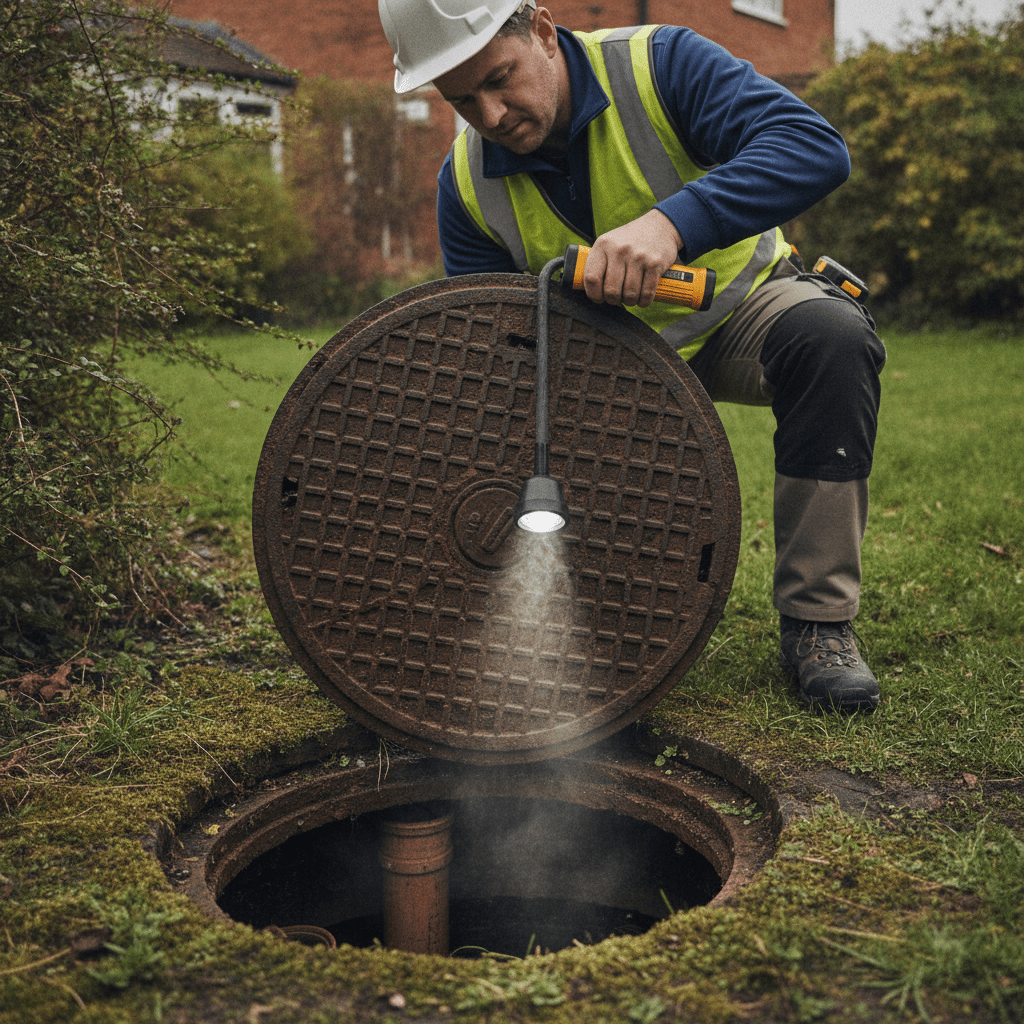
A RICS Level 2 or Level 3 survey is a visual inspection of what is accessible. On a property with private drainage, that means your surveyor will look for the things that are visible above ground and infer the rest.
- Evidence of the system’s location — manhole and inspection chamber covers, a tank lid, a treatment plant housing, vent pipes, and the likely run of the drainage field.
- Condition of what can be lifted and seen — chamber covers that can be safely lifted, the condition of the brickwork or plastic within, and whether water is flowing away as it should.
- Ground evidence of failure — soggy, unusually green or sunken ground over the drainage field, standing water, or odour, all of which point to a field that is no longer soaking away.
- Distance and layout concerns — a tank sited very close to the house, a boundary, a well or a watercourse.
- The knock-on effects inside — slow-draining fittings, gurgling, or signs of past backing-up.
On a RICS Level 3 Building Survey, the drainage commentary is more detailed and more willing to reach a view on likely remedial work — which is one reason we usually recommend Level 3 on older rural properties rather than a Level 2.
What Your Survey Will Not Tell You — and This Is the Bit Most Guides Skip
Here is the honest limitation, and knowing it early saves a lot of frustration after the report lands.
A survey cannot confirm that a private drainage system is legally compliant. Compliance depends on when the discharge started, where it goes, how big it is, what British Standard the system met when it was installed, and what is within a certain distance of the discharge point. None of that is visible from a walk round the garden. Our post on what a home survey won’t cover sets out the wider boundary; private drainage is one of the clearest examples of it.
A survey also cannot tell you the internal condition of the tank, because the tank is full. It cannot tell you whether the drainage field was built to the right size or the right specification, because it is buried. And it cannot tell you how the system performs under load — a tank can look perfectly serene in an empty house and fail within a fortnight of a family of five moving in.
The practical takeaway
Use the survey to find out whether there is a problem you can see, and use the seller’s paperwork plus your solicitor’s enquiries to find out whether there is a problem you cannot. Neither one replaces the other.
The General Binding Rules, in Plain English
The general binding rules are the Environment Agency’s way of letting most small domestic systems operate without an individual permit — provided they meet a set of conditions. If a system cannot meet them, the owner needs a permit or has to change the system.
These are the conditions that most often catch a buyer out:
| Rule | What it means in practice |
|---|---|
| Volume limits | No more than 2 cubic metres (2,000 litres) a day to ground, or 5 cubic metres (5,000 litres) a day to surface water. Extending the house or connecting another property can push a system over the line. |
| Septic tanks must not discharge to a watercourse | If one does, it must be connected to a sewer, replaced with a treatment plant, or given a drainage field — with plans to do the work in a reasonable timescale, usually 12 months. |
| Correct drainage field | A rainwater soakaway is not a drainage field, and a well or borehole cannot be used to dispose of waste water. Drainage fields should follow British Standard BS 6297:2007. |
| Distance from water supplies | Anywhere within 50 metres of a private water supply used for drinking counts as a groundwater source protection zone, and needs a permit rather than the general binding rules. |
| Maintenance and emptying | Sludge must be removed before it exceeds capacity — at least once a year, or as the manufacturer specifies — by a registered waste carrier. |
| Telling the next owner | On sale, the seller must provide written details of the discharge and the system. |
The rules also differ depending on when the discharge started, with tighter conditions for discharges begun on or after 1 January 2015 and tighter ones again from 2 October 2023. That is why the age of the installation is one of the first questions to ask.

The Paperwork to Ask For Before You Exchange
Ask for these through your solicitor as early as you can. Chasing them at the point of exchange is where deals lose weeks.
- The seller’s written discharge statement — the description of the system, where it is, where it discharges, and how it should be maintained. This is a requirement, not a courtesy.
- The installation date and the type of system — this determines which set of rules applies.
- Manufacturer’s documentation — the manual, and any certificate of compliance with a British Standard.
- Emptying and servicing invoices — ideally covering several years. A tank that has not been emptied in a decade is a different proposition from one serviced annually.
- Building Regulations and planning records for the installation, if it is not original to the house.
- Any environmental permit, if the system is one that needs one.
If the seller cannot produce the written discharge details, that is not automatically a reason to walk away — but it does mean nobody has checked compliance, and you should not assume somebody else has.
What to Look For Yourself on the Viewing
You do not need a surveyor’s eye to notice most of the early warnings, and spotting them before you instruct means you can ask your surveyor to look specifically.
- A patch of grass over the drainage field that is greener, lusher or wetter than everything around it in dry weather.
- Standing water, or ground that squelches underfoot well away from any downpipe.
- Smell — particularly near a ditch, a boundary, or the tank itself on a still day.
- A ditch or stream close to the house with a visible outfall pipe running into it.
- Air fresheners or plug-ins concentrated in a ground-floor cloakroom or utility.
- Slow drainage or gurgling when a bath or sink empties.
Several of these also appear on our list of general house survey red flags, and for the same reason — they are cheap to notice and expensive to discover late.
Buying a House with a Septic Tank: Who Pays If the System Has to Be Replaced?
This is the question that decides whether a non-compliant system is a problem or a negotiating position. The Environment Agency’s answer is that where a property with a septic tank discharging to a watercourse is bought or sold, buyer and seller should agree between them who is responsible for the replacement or upgrade, as a condition of sale.
In other words, the law does not decide it for you — the contract does. And the moment you complete, the obligation sits with you as the new operator of the system, whatever anyone said over the phone.
So if the survey and the paperwork together suggest the system needs work, the time to deal with it is before exchange: either as a price adjustment, as a retention, or as a seller obligation written into the contract by your solicitor. After completion you have lost the leverage and kept the liability.
Our view
Off-mains drainage is rarely a reason not to buy a house. Thousands of properties across Rutland and south Lincolnshire run perfectly well on private systems for decades. It is, however, one of the few things that can turn into a substantial and non-negotiable cost the day after completion — which is exactly why it deserves attention before it, not after.
How This Fits With the Rest of Your Drainage Checks
Private drainage sits alongside the below-ground pipework that carries waste from the house to the tank in the first place. A surveyor will flush and observe the accessible parts of that system, but the buried runs are a separate question — which is why a CCTV drain survey is sometimes the sensible next step. We cover the general position in our guide to whether a home survey checks the drains.
On a rural property, we would normally suggest treating the two together: understand the tank and its drainage field, and understand the pipework feeding it. A fault in either produces the same symptoms, and the remedies are completely different.
Frequently Asked Questions
Does a home survey include the septic tank?
A RICS home survey includes the drainage that is visible and accessible, which will normally mean identifying that a private system is present, commenting on its apparent condition, and noting any ground evidence of failure. It does not include opening or emptying the tank, testing the drainage field, or confirming that the system complies with the general binding rules. Those are separate investigations, and your surveyor will say so in the report.
Can you get a mortgage on a house with a septic tank?
Off-mains drainage is common enough in rural England that it is not, in itself, an obstacle. Lenders generally want to be satisfied that the property has an adequate and lawful means of foul drainage, and your solicitor’s enquiries are usually where that gets established. Where a system is clearly non-compliant or in poor condition, expect it to become a condition or a retention rather than an outright refusal.
How often does a septic tank need emptying?
The general binding rules require sludge to be removed before it exceeds the system’s capacity — at least once a year, or in line with the manufacturer’s instructions, whichever is more frequent. The work must be done by a registered waste carrier, and it is worth asking the seller for the invoices, because a regular emptying history is one of the better indicators that a system has been looked after.
What happens if I find out after completion that the system is not compliant?
The obligation follows the property, so it becomes yours. In practice that means either bringing the system up to standard, connecting to a public foul sewer where one is reasonably close, or applying for an environmental permit. It is recoverable, but it is far cheaper as a pre-exchange negotiation than as a post-completion discovery — which is the whole argument for raising it early.
Buying a rural property with private drainage?
Blue Blossom Surveys is RICS-regulated with over 35 years of surveying experience across Peterborough, Stamford, Grantham, Oakham, Bourne, Corby and the surrounding villages. If you tell us the property is off mains drainage when you instruct, we will pay particular attention to it and set out clearly what we could and could not see. Get in touch for a no-obligation conversation about the right survey level.






0 Comments