

In this guide
Public health guidance on wood-boring insects makes a point most sellers and quite a few buyers have never heard: on an old infestation the holes go dark inside, whereas the interiors of holes from a current infestation are the colour of freshly cut timber. Same beetle, same holes, completely different problem.
That single distinction is why “woodworm found” in a survey report causes far more alarm than it usually deserves — and, occasionally, far less than it should.
In short: Woodworm flagged in a survey means a surveyor has seen beetle exit holes in timber. It does not by itself mean beetles are still in the wood. Pale, clean-edged holes with fresh bore dust suggest activity; grey, dust-free holes in dry timber usually mean an infestation that ended years ago. Rot is a separate finding with a separate cause — water — and it is generally the more urgent of the two.
Old holes are not an active infestation
Most timber in most older houses in Peterborough, Stamford and the surrounding villages carries some evidence of beetle activity somewhere. Floor joists, loft timbers, the underside of stair treads, old furniture left behind by the vendor. Finding holes is normal. Establishing whether anything is still living in the wood is the actual question.
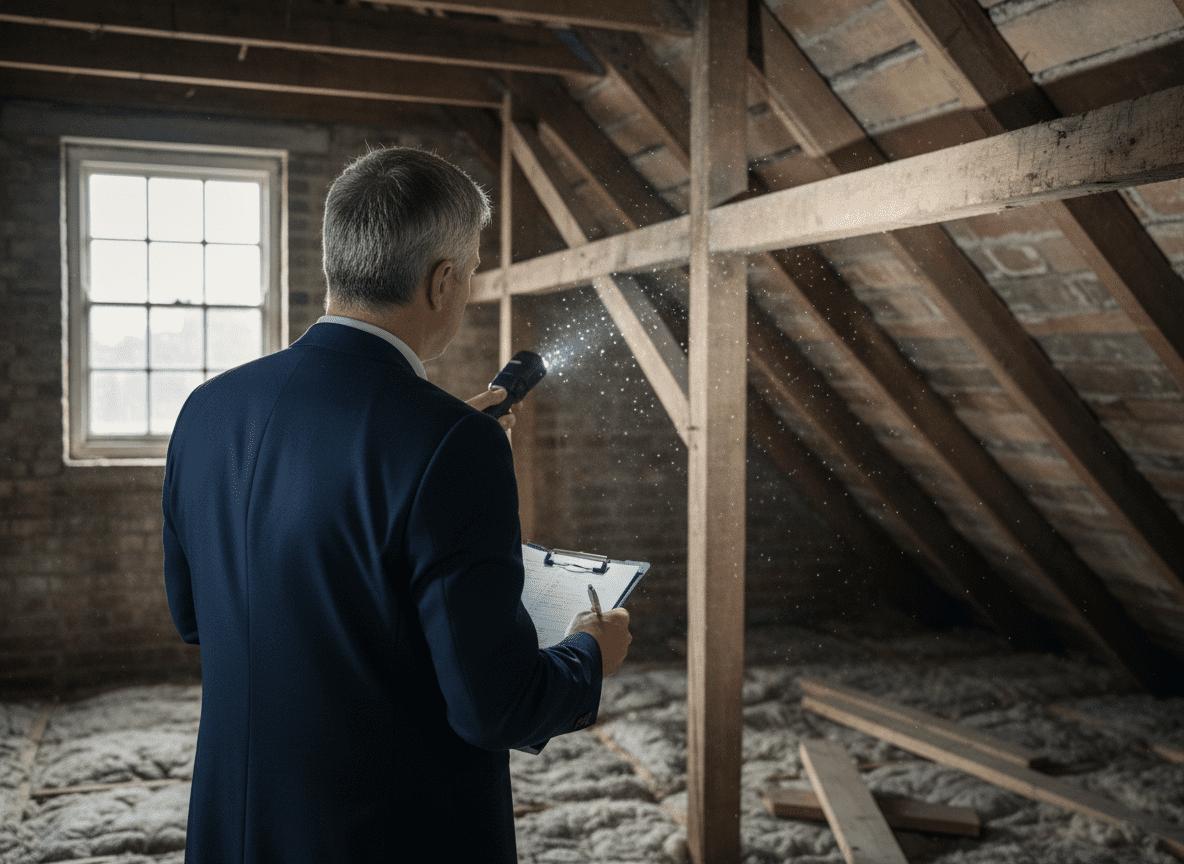
Three signals point towards a current infestation:
- Fresh bore dust. Frass is fine, gritty and pale, and it accumulates below the holes. The council guidance above describes the common furniture beetle’s frass as lemon-shaped under magnification, and notes its holes run to roughly one to two millimetres across.
- Clean, pale hole interiors. Newly cut edges, no dust settled in them, timber-coloured inside rather than grey.
- Beetles themselves. Adults emerge between roughly May and September. Dead beetles on window sills or in the cobwebs under a floor are strong evidence.
Where it is genuinely unclear, the standard approach is time rather than treatment. That same guidance suggests monitoring for a year if you are unsure — clean the surface beneath a suspect area and the sills near it, then see whether anything accumulates. Emerging beetles announce themselves.
The species matters as well. The common furniture beetle accounts for the overwhelming majority of what turns up in ordinary housing. Death watch beetle is a different proposition, favours partially decayed hardwood, principally oak, and is far more often associated with historic buildings and churches than with a 1930s semi.
Woodworm and rot are different findings
Reports sometimes group these together under a timber heading, which blurs a distinction worth keeping sharp.
| Woodworm | Rot | |
|---|---|---|
| What it is | Larvae of wood-boring beetles feeding inside the timber | Fungal decay breaking the timber down |
| What you see | Exit holes, bore dust, weakened surface | Softened, crumbling or cracked timber, staining, sometimes a musty smell |
| Root cause | Moisture in the timber makes it habitable; beetles do the rest | Water. Always water |
| Typical urgency | Often historic and stable | Progressive while the water source remains |
| The real fix | Dry the timber, then treat if activity is confirmed | Find and stop the water, cut out and replace affected timber |
Within rot there are two broad families. Wet rot is far more common, stays local to the wet timber, and stops advancing once the water is dealt with. Dry rot is the one that earns its reputation: it can transport moisture through its own growth, travel across and through masonry, and continue into timber that is not itself wet. It is much rarer, and it is the finding that justifies moving quickly.
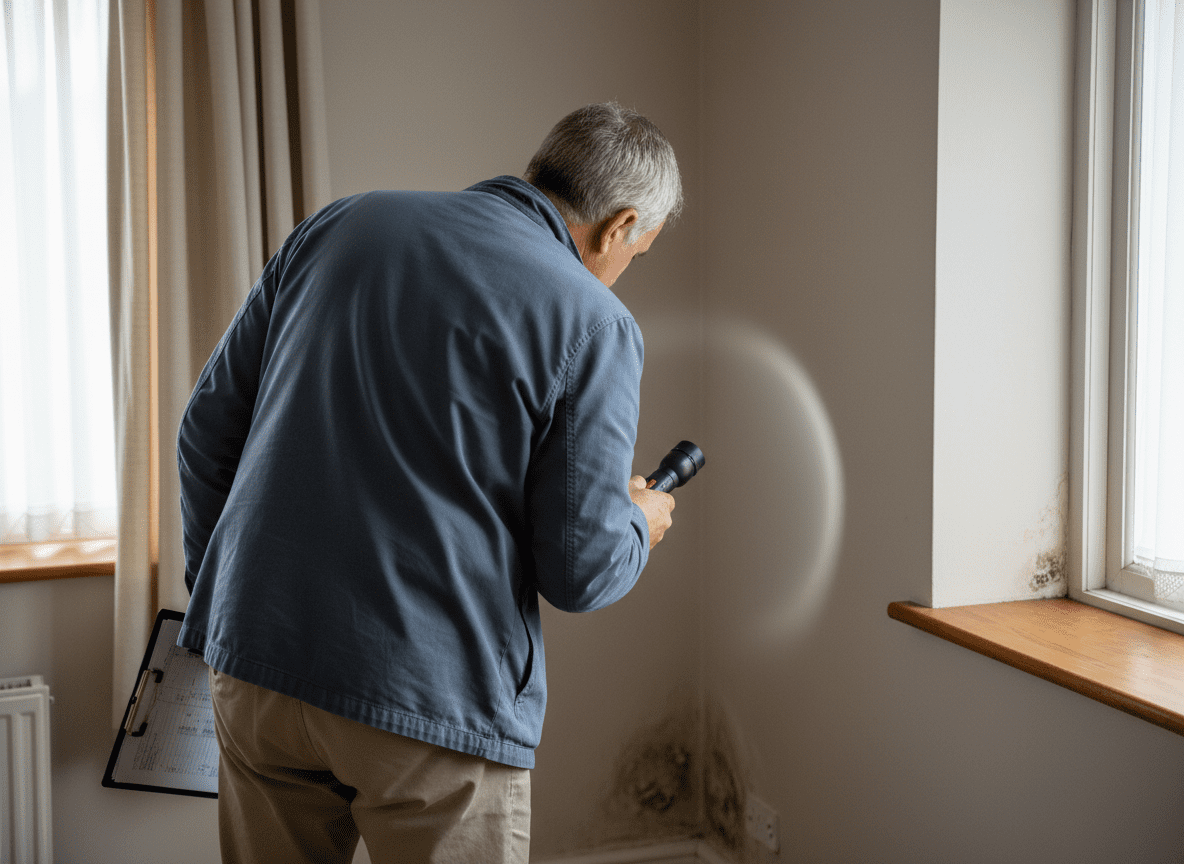
The common thread is that both findings are symptoms. A beetle infestation needs timber with a raised moisture content to establish; fungal decay needs water outright. Which is why a report that flags timber decay will almost always also be pointing at a roof, a gutter, a leaking pipe or ventilation as the thing that actually needs attention.
Where it turns up in a survey
Roof spaces are the most common location, because loft timbers are accessible, uninsulated from moisture movement, and easy to inspect. Suspended timber ground floors are next, particularly where air bricks have been blocked by a driveway, a border or a later extension — cut the ventilation under a timber floor and you create precisely the conditions both problems need.

Cellars, the ends of joists built into external walls, timber in contact with the ground, and the base of stairs against an external wall all feature regularly. Older extensions and converted spaces are worth particular attention, which is one reason what a surveyor inspects on an extension is a question worth understanding before the inspection rather than after it.
Why your surveyor stops short of a verdict
A survey is a visual inspection. Your surveyor is not lifting fitted carpets, taking up boards, opening ceilings or exposing joist ends. So the report will describe what was visible, assess how likely the activity is to be current, and recommend further investigation where the evidence is ambiguous or the timber is structurally significant.
There is a commercial point buried in that caution, and it is worth stating plainly. A great many “free timber surveys” in the UK are provided by contractors who make their money from the treatment that follows. An independent RICS surveyor has no product to sell you. When we say the holes look historic and no treatment is warranted, there is nothing riding on that answer.
Where the report does recommend specialist investigation, ask the specialist for their evidence of current activity before authorising any chemical treatment. If nothing is living in the timber, treatment achieves nothing except a certificate.
A Level 3 Building Survey is the appropriate level where the property is older, has a suspended timber floor, or where you already suspect timber problems — it goes further into construction and condition than a Level 2 does, and gives you commentary you can actually negotiate with.
What putting it right involves
Prices vary enormously with access, extent and what the timber is doing structurally, so treat the following as market context only.
Localised beetle treatment of a confirmed active infestation in an accessible loft typically starts from around £500. Larger or less accessible areas, or work involving replacement of weakened joists, runs a good deal higher. Rot is priced differently again, because the cost sits in the building work — finding and stopping the water, cutting out decayed timber, replacing it and making good — rather than in the treatment itself.
These are guide figures only and not a quote. Blue Blossom Surveys does not carry out timber treatment or remedial work and has no interest in the figure. Every job depends on the individual property, and you should get at least two written quotations, each supported by evidence of what is actually there.
What to do with the finding
- Read what the report actually says. “Historic beetle activity, no evidence of current infestation” and “active infestation requiring treatment” are different sentences with very different consequences.
- Deal with the water first. If rot is present, or if the timber is wet, the source is the priority. Treatment applied to timber that is still getting wet is money spent on the symptom.
- Get independent evidence before treatment. Ask what indicates current activity and ask to see it.
- Price the work before you renegotiate. Two written quotations give you something concrete to take back to the agent rather than a number you have guessed.
- Decide what it changes. Most timber findings are manageable and priceable. Our guidance on handling a report that has found problems and on renegotiating on the back of survey findings covers how to use it without losing the purchase.
Buyers of period property in particular should keep this in proportion: some beetle evidence in century-old timber is close to expected, and it is the presence of moisture, not the presence of holes, that determines whether it matters. Our guide to surveying an older property properly sets out what else to be looking at while you are there.
Frequently asked questions
Should I pull out of a purchase because of woodworm?
Almost never on that basis alone. A great deal of what is reported is historic activity in timber that has been dry for decades and is structurally sound. What would change the picture is an active infestation in significant structural timber, or beetle evidence appearing alongside rot in joist ends or roof members. In those cases the correct response is investigation and a costed quotation, then a decision about price rather than an automatic withdrawal.
How can I tell if woodworm is still active?
Look for fine, pale bore dust below the holes, and for hole interiors that are the colour of freshly cut timber rather than grey and dusty. Dead beetles on nearby window sills between late spring and early autumn are strong evidence. Where it is unclear, clean the surrounding surfaces and monitor for a year — emerging beetles will make themselves known, and treating on suspicion achieves nothing if the wood is already empty.
Will a mortgage lender lend on a house with woodworm or rot?
Usually yes, though it depends on the extent and on what the lender’s valuer reports. Minor historic beetle evidence rarely attracts comment. Significant timber decay, structural weakening or dry rot may lead a lender to hold back part of the advance until the work is completed and evidenced, or to ask for a specialist report first. Tell your broker as soon as the finding appears rather than waiting for the lender to raise it.
Is a timber and damp report from a treatment company the same as a survey?
No. Those inspections are typically free, are usually carried out by a contractor who sells the remedial work, and are confined to the specific defect. An RICS survey is an independent, paid assessment of the whole property with no remedial work attached to it. Both have a place — but the independent assessment should come first, and it should be the thing that decides whether the specialist is needed at all.
If a report has flagged timber decay and you are unsure how much weight to give it, an independent opinion is worth having before you commit. Blue Blossom Surveys covers Peterborough, Stamford, Grantham, Oakham, Corby, Wisbech and the surrounding area, carrying out RICS Level 2 Homebuyer Surveys and RICS Level 3 Building Surveys. We identify it; we do not sell the treatment. Get in touch to talk it through.
Reviewed and signed off by Blue Blossom Surveys. Published 22 October 2026. Last updated 22 October 2026.




0 Comments