

In this guide
Most guides to non-standard construction treat it as one category of risk. It is not. There is a specific list of house types that Parliament designated as defective in law, there is a much larger group of unusual but perfectly sound houses, and lenders treat the two completely differently. Knowing which side of that line a property sits on changes the survey you need and the price you should be paying.
If you are buying a prefabricated concrete house, a steel frame house, a system-built council house bought under Right to Buy, or anything else that is not brick or block with a cavity, this is the sequence to work through before you commit.
In short: a non standard construction survey is normally a Level 3 building survey, not a Level 2. Non-standard means anything not built of traditional masonry — concrete panel, steel frame, timber frame, cob, thatch, no-fines. Lenders are cautious because a subset of these types were formally designated as defective under 1980s housing legislation, and because each lender sets its own criteria. A mortgage valuation will not tell you what you need to know.
What counts as non-standard construction
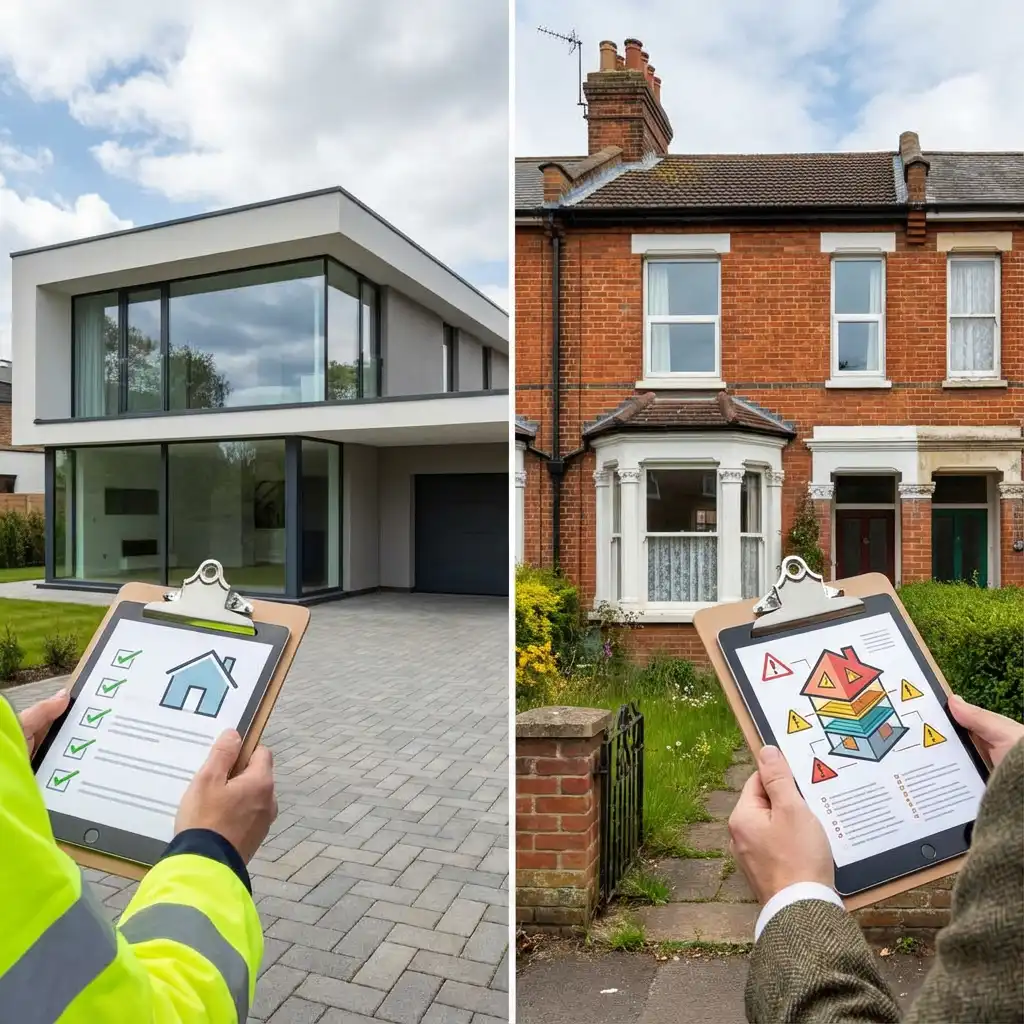
“Non-standard” is a lending and insurance term rather than a technical one. It simply means the house is not built with masonry walls under a slate or tile roof, which is what most UK underwriting assumes by default.
In and around Peterborough, Corby, Grantham and the surrounding towns, the types that come up most often are post-war system-built housing sold off by councils, steel-framed houses from the 1920s to the 1960s, and concrete panel construction. Further out you also see cob, clay lump, thatch and single-skin stone in the older village stock.
Timber frame deserves a separate mention, because it is the one type on this list that is both non-standard for lending purposes and completely mainstream in modern construction. We have a dedicated guide to surveying a timber frame house that covers it properly — the inspection priorities there are different enough that it does not belong in this article.
The rest of this piece is about concrete, steel and system-built housing, where the lending problem is sharpest and the survey question is least well understood.

“Designated defective” is a real legal category
This is the part that gets flattened into vague warnings elsewhere, and it is worth being precise about.
After the war, severe housing shortages produced a boom in non-traditional building methods. Investigations by the Building Research Establishment later found real problems with some of them — in prefabricated reinforced concrete construction, steel reinforcing rods were found to have rusted, cracking the surrounding concrete. In response, the Housing Defects Act 1984, later consolidated into Part XVI of the Housing Act 1985, created a statutory scheme for people who had bought an affected house from a public authority without knowing.
Under that scheme the Secretary of State formally designated specific house types as defective. The House of Commons Library’s briefing on construction defects lists them by name: Airey, Boot, Boswell, Cornish Unit, Dorran, Dyke, Gregory, Myton, Newland, Orlit, Parkinson, Reema Hollow Panel, Stent, Stonecrete, Tarran, Underdown, Unity and Butterley, Waller, Wates and others.
Three things follow from that, and they are the useful part.
- Designation was about a known manufacturing defect, not about looking unusual. A house type not on the list is not automatically fine, and a house type on the list is not automatically unmortgageable — many have since been structurally repaired.
- The assistance scheme has closed. The grants and repurchase provisions are historic. If you buy one of these today, the defect and its consequences are yours.
- A repaired designated house is a different proposition from an unrepaired one, and the evidence of that repair — the scheme, the engineer, the certification — is what lenders and future buyers will ask for.
Why lenders are cautious
There is no central rulebook here, and that is exactly the problem. As the same Commons Library briefing puts it, lenders are free to decide which properties they will and will not offer a mortgage on. Two buyers with identical deposits can get opposite answers on the same house.
What a lender is really trying to establish is whether the property is readily saleable if they ever have to repossess it. That is a resale question as much as a structural one, which is why a repaired Airey house with full documentation is easier to finance than an untouched one with none, even where the physical risk is now comparable.
In practice you should expect some combination of the following: a smaller panel of willing lenders, a larger deposit requirement, an instruction to your valuer to comment specifically on construction type, and a request for a full structural report before an offer is confirmed.
The realistic move is to talk to a broker who has placed this type of property before, and to do it before you offer rather than after. Which lenders will consider which construction types is live information that changes, and it is not something a survey can answer for you.

Which survey level you actually need
| Inspection | What it is for | Right for non-standard? |
|---|---|---|
| Mortgage valuation | The lender’s own assessment of security value | No — it is not for you and will not diagnose the construction |
| RICS Level 2 Homebuyer Survey | Conventional, reasonably modern houses in reasonable condition | Rarely — the scope is not built for unusual construction |
| RICS Level 3 Building Survey | Older, altered, unusual or visibly compromised buildings | Yes — this is the normal answer |
| Specialist structural engineer’s report | A specific structural question, often with testing or opening up | Sometimes — as the next step after a Level 3, where required |
The reason is scope rather than diligence. A Level 2 is a condition-rated inspection designed around conventional housing. A Level 3 building survey is a detailed investigation of construction and defects, with the depth to describe how a building was put together and what that means for its future. On a concrete panel or steel frame house, that description is the entire value of the exercise.
If you are weighing that up in general terms rather than for a non-standard house specifically, our comparison of the two survey levels sets out where the line usually falls.
What a survey can and cannot tell you
Being clear about the boundary here is important, because some of what gets promised online is not deliverable by anybody.
A Level 3 will identify the construction type, place it in its period, report the visible condition of the structure, cladding and roof, and flag the specific failure signatures associated with that type — spalling and cracking around reinforcement in concrete construction, corrosion at wall plate and frame junctions in steel-framed houses, condensation and cold bridging where later overcladding has been applied.
It will also tell you plainly when the finding needs a specialist rather than an opinion, and give you something concrete to take to your broker and your solicitor.
What it will not do is issue a structural certificate. Confirming that a designated defective house has been repaired to an approved scheme, or certifying a repair, is a structural engineer’s work. We are not the ones who issue that document, and any surveyor telling you otherwise is overselling.
The distinction that matters: a survey tells you what the building is and what condition it is in. A structural engineer’s report certifies what has been done to it. On a designated defective type, buyers usually need both — in that order, because the survey is what establishes whether the second one is necessary.
Buying one anyway
None of this is an argument against buying non-standard. These houses are frequently good value, often generously proportioned by modern standards, and the caution surrounding them is partly a lending artefact rather than a structural verdict.
What changes is the order you do things in. Establish the construction type before you offer, not after the valuer flags it. Get the broker conversation done early. Commission a Level 3 rather than a Level 2. Ask the seller directly for any repair documentation and treat its absence as a live question rather than an oversight.
And price the exit as well as the entry. A house that is harder to finance is harder for your buyer to finance too, and that shows up in the resale market long before it shows up in the brickwork. If the survey does turn something up, our guide to what to do when a report finds problems covers how to handle the findings without losing the purchase.
Frequently asked questions
Can you get a mortgage on a non-standard construction house?
Often, yes, but the panel of willing lenders is smaller and the terms are usually less generous. Lenders set their own criteria, so a refusal from one is not a verdict on the property. Expect a larger deposit to be asked for, and expect the lender to want its valuer’s comment on construction type before confirming. Speak to a broker with experience of the specific construction before you make an offer.
Is a Level 2 survey enough for a prefab or steel frame house?
Generally no. A Level 2 is scoped for conventional properties in reasonable condition, and the questions that matter on non-standard construction sit outside it. A Level 3 building survey is the appropriate level, and it is the one that will describe how the house is built rather than simply rating what can be seen.
What does “designated defective” actually mean?
It is a formal designation made under the Housing Defects Act 1984, later part of the Housing Act 1985, applied to named house types found to have an inherent construction defect. It came with a statutory assistance scheme for affected owners, which has since closed. The designation attaches to the house type, not to a specific property — many individual houses of designated types have since been repaired.
Will insurance be a problem as well as the mortgage?
It can be. Buildings insurance for non-standard construction is usually available but often through specialist rather than mainstream insurers, and premiums can be higher. It is worth getting an indicative quote at the same stage as the mortgage conversation, because both are easier to sort out before you are committed than during a chain.
Does a repaired PRC house still count as non-standard?
Yes. Repair improves the structural position and materially improves mortgageability, but the construction type does not change and lenders will still treat the property as non-standard. What changes is the evidence you can put in front of them — which is why the repair documentation is worth chasing hard before you exchange.
If you are buying something that is not conventional brick and block and want to know what you are actually taking on, an independent inspection is the right first step. Blue Blossom Surveys covers Peterborough, Stamford, Grantham, Oakham, Corby, Wisbech and the surrounding area, carrying out RICS Level 2 Homebuyer Surveys and RICS Level 3 Building Surveys. We report on what is there; we do not sell the remedial work. Get in touch to talk it through.
Reviewed and signed off by Blue Blossom Surveys. Published 29 October 2026. Last updated 29 October 2026. Lending and insurance criteria change — check the current position with a broker before relying on it.




0 Comments