

What Does a New Build Snagging Survey Actually Find?
One of the most common questions from new build buyers is whether a snagging survey is really worth it. The assumption is sometimes that a brand new home will be in near-perfect condition. In practice, snagging surveys consistently find a wide range of issues – and the earlier they are identified, the easier and less costly they are to resolve.
Here is a practical overview of what a snagging survey typically uncovers, and why finding these issues before you complete – or shortly after moving in – matters.
What is a snagging survey?
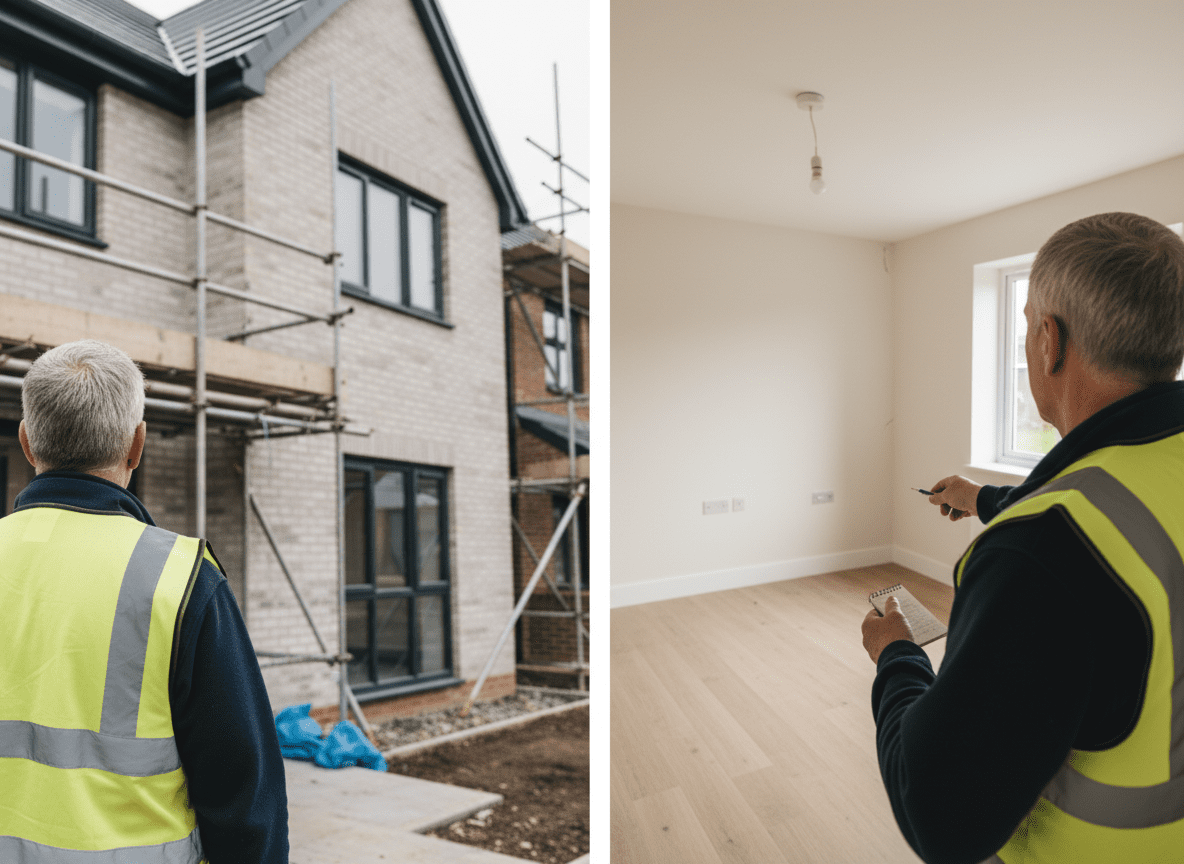
A new build snagging survey is a detailed inspection of a newly constructed property designed to identify defects, unfinished work, and deviations from the specification before or after handover.
The inspection covers the full property – externally and internally – and produces a written snagging list that the buyer can submit to the developer. The developer is then responsible for addressing valid items within a defined period.
There are two common points at which a snagging survey is carried out:
- Pre-completion – before legal completion, ideally with the developer permission to access the property in advance of handover. This is the preferred timing because it gives the developer a clear window to address items before you move in.
- Post-completion – after moving in, using the developer defects period (typically two years under NHBC Buildmark) to raise outstanding issues.

Finishing and cosmetic defects
Finishing defects are the most frequently found category in snagging surveys. Although they are often described as minor, a significant number of them in one property reflects poor quality control and can be frustrating to live with if left unaddressed.
Paintwork and plasterwork
Missed paint coverage, brush marks, drips, paint on fixtures and fittings, poorly finished cutting in around skirtings and ceilings – these are among the most common findings. Plasterwork issues include cracks at junctions, poor finishing around door frames, and surface imperfections that become more visible once the property is lived in and lit naturally.
Carpentry and joinery
Poorly fitted skirting boards, architraves that are not flush, internal doors that do not close or latch cleanly, wardrobe and kitchen unit doors that are misaligned, and gaps between units and walls are typical findings. These items are relatively quick to fix when identified early but can be overlooked once a property is furnished.
Tiling and flooring
Cracked or chipped tiles, uneven tile joints, areas of poor adhesion particularly in wet rooms, and flooring that is not properly secured or is lifting at edges. In bathrooms and en suites, inadequate grouting or gaps at the base of shower enclosures can allow water ingress if not addressed.
Structural and build quality issues
Beyond finishing defects, snagging surveys often identify issues with the structure or build fabric of the property. These are generally more significant and worth raising formally with the developer.
External walls, brickwork, and render
Poor pointing, inconsistent mortar joints, mortar smears on brickwork, cracks at window and door reveals, inadequate weep holes in cavity walls, and render that is uneven or beginning to crack at junctions. Externally, these issues are most visible on close inspection but can allow water entry if overlooked.
Roof covering and guttering
Ridge tiles that are not properly bedded, displaced or missing clips on roof tiles, incorrectly fitted verge details, and guttering that has inadequate falls or is already sagging or leaking at joints. Flat roof areas on extensions or garages may show poor detailing at upstands or parapets.
Windows and doors
Double glazed units with condensation or misting between panes (indicating failed seals), poorly adjusted hardware, damaged frames or sills, draught gaps around frames, and external doors that do not close flush or require significant effort to operate.

Mechanical and services installations
Surveys frequently identify issues with how services have been installed. These range from purely cosmetic to genuinely functional concerns.
Heating systems
Radiators that are not level, pipework that is poorly clipped or runs in a way that creates an eyesore, thermostatic radiator valves that are missing or incorrectly fitted, and heating zones that have not been properly commissioned or balanced.
Electrical installation
Socket and switch faceplates that are not flush, badly positioned sockets relative to kitchen units, missing cover plates, and areas where cable runs are visible or poorly hidden. More seriously, where commissioning tests are not provided as part of the handover documentation, this is something worth querying.
Plumbing and drainage
Poorly sealed pipe penetrations through walls, silicone that has been applied unevenly or is already separating in wet rooms, inadequate clearances under kitchen sinks, and visible pipe clips that have not been properly fixed. Drainage falls – the gradient at which water runs away – are sometimes found to be inadequate, particularly in ground floor bathrooms.
Practical tip: When reviewing the snagging list with your developer, prioritise any items that could worsen over time – particularly those involving water ingress, drainage, or heating performance. These are most important to resolve before the formal defects period expires.
How many defects does a typical snagging survey find?
The number varies significantly by developer, property size, and how close to the original handover date the inspection takes place. It is not uncommon for a detailed snagging inspection of a standard three or four bedroom new build to identify between 50 and 150 individual snags across the range of categories described above.
Not all of these will be significant – many finishing items are resolved quickly. But having a documented and prioritised list, prepared by an independent surveyor, places the buyer in a much stronger position than compiling a list themselves after moving in.
What happens after the snagging survey?
Once you have the snagging list, the process works as follows:
- Submit the list formally to the developer customer care team – in writing, by email, so there is a clear record.
- Keep a copy of every response and any agreed rectification schedule.
- Arrange access for the developer contractors and confirm that items have been resolved before signing them off.
- For any items you believe are being dismissed improperly, the NHBC (if your property is covered by Buildmark) has a dispute resolution process available.
A pre-completion inspection by an independent surveyor such as Blue Blossom Surveys gives you the best opportunity to have items resolved before completion, when the developer contractors are most likely to still be on site.
Frequently Asked Questions
Will the developer allow access for a pre-completion snagging survey?
Developers are not legally obliged to allow access before legal completion. However, many will agree to it, particularly if asked in advance and in writing. If a developer refuses, a post-completion snagging survey carried out promptly after moving in is the next best option.
How long after moving in can I still raise snagging defects?
Under the NHBC Buildmark warranty, the developer is responsible for resolving defects reported during the first two years after completion. Beyond that, insurance provisions apply to structural defects for up to ten years. The two-year defects period is the most practical window for resolving finishing and build quality issues.
Is a snagging survey only useful on a new build?
Snagging surveys are specifically designed for new build properties. For older homes – including recently refurbished or converted properties – a Level 2 or Level 3 survey is more appropriate.
What is the difference between a pre-completion inspection and a snagging survey?
These terms are often used interchangeably. At Blue Blossom Surveys, a pre-completion inspection takes place before handover, while a snagging survey can be carried out either before or after completion. The inspection process and the type of defects identified are very similar in both cases.
Buying a new build in Peterborough or the surrounding area? Blue Blossom Surveys offers independent pre-completion inspections and post-completion snagging surveys across Cambridgeshire, Lincolnshire, Northamptonshire, and Rutland. Contact us to book or discuss your new build survey – we are here to help you get the most from your purchase.
Wondering what a snagging survey costs before you book one? Our 2026 pricing guide covers snagging survey costs by property size, the difference between a pre-completion inspection and a post-completion survey, and what the fee includes.




0 Comments